
Fluorinated greenhouse gases, also known as “F-gases”, are man-made chemicals used in many sectors and applications, and most of them contribute to global warming.
In particular, they are:
– HFCs, used as refrigerants in refrigeration and air-conditioning systems and in heat pumps, as blowing agents for foams, as extinguishing agents in fire protection systems and, finally, as aerosol propellants and solvents.
– PFCs, used in electronics and in the cosmetics and pharmaceutical industries, as well as in certain refrigeration systems as substitutes for CFCs. PFCs may still be found in old fire protection systems.
– SF6, used as an insulating and arc-quenching gas in high-voltage switchgear (switches) and as a process gas in the production of magnesium and aluminium.
The general objective of the regulation on so-called “F-gases” is to reduce emissions of these gases through a series of measures or actions taken at every stage of their life cycle.
They became widespread from the 1990s onwards as substitutes for some ozone-depleting substances (chlorofluorocarbons (CFCs) and hydrochlorofluorocarbons (HCFCs)), which were gradually phased out under the Montreal Protocol.
Fluorinated gases do not contribute to ozone depletion; however, most of them have a high global warming potential (GWP).
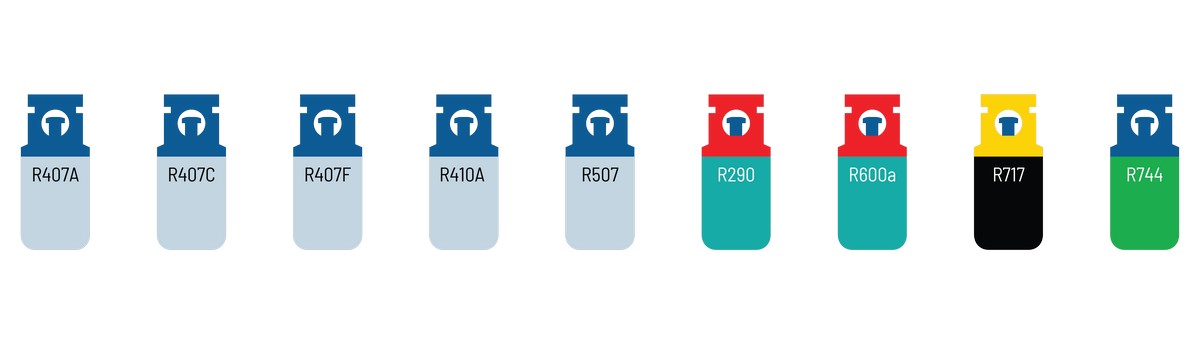
HFCs are the most common group of fluorinated gases.
They are used in various sectors and applications, for example as refrigerants in refrigeration and air-conditioning systems and in heat pumps, as blowing agents for foams, as extinguishing agents in fire protection systems, and as aerosol propellants and solvents.
PFCs are normally used in the electronics sector (for example for plasma cleaning of silicon wafers) and in the cosmetics and pharmaceutical industries (extraction of natural products such as nutraceuticals and flavourings), but to a lesser extent also in refrigeration systems as substitutes for CFCs – often in combination with other gases.
In the past PFCs were used as extinguishing agents, and they may still be found in older fire protection systems.
SF6 is mainly used as an insulating and arc-quenching gas in high-voltage switchgear (switches) and as a cover gas in the production of magnesium and aluminium.
Within the general framework of the international protocols to combat climate change (Montreal Protocol, Kyoto Protocol), the European Union has actively committed itself to reducing emissions of ozone-depleting substances and greenhouse substances.
Both families of substances belong to the fluorocarbons, man-made chemicals containing fluorine and carbon. By adding chlorine atoms to fluorine and carbon, chlorofluorocarbons (or CFCs) were synthesised which, thanks to their chemical/physical characteristics (high chemical and thermal stability, low flammability and low toxicity), found widespread use in various industrial processes, despite their high environmental impact due to the depletion of the stratospheric ozone layer.
Hydrochlorofluorocarbons (or HCFCs) are also considered responsible for the thinning of the ozone layer, although the presence of hydrogen atoms in the molecule makes them less dangerous than CFCs. Halons, hydrocarbon compounds containing bromine atoms, were used mainly as extinguishing agents and have a high ODP (ozone depletion potential).
Since 1 January 1996 the production of CFCs has been banned in industrialised countries, while HCFCs are being gradually phased out by 2030, a deadline brought forward to 2015 in the European Community.
The alternatives to the use of CFCs and HCFCs are again synthetic substances, such as hydrofluorocarbons (or HFCs), perfluorocarbons (PFCs) and sulphur hexafluoride (SF6) which, being free of chlorine, have zero ozone depletion potential (ODP), but at the same time contribute to global warming (greenhouse effect), having a high GWP (global warming potential). The GWP, specific to each gas, is a value calculated on the basis of the warming potential over 100 years of one kilogram of a fluorinated gas relative to one kilogram of CO2 (another gas, but of natural origin, with a high warming power, like methane).
Although European legislation has banned the production and sale of all ozone-depleting substances, these are still present in a great many systems and their recovery is considered an environmental priority.