
Freons with a single carbon atom are generally produced by chemical synthesis, by replacing hydrogen with halogens in the structure of methane. Replacing a hydrogen atom with a fluorine atom is a relatively simple operation that causes an increase in density, while replacing a hydrogen atom with a chlorine atom generally causes an increase in the latent heat of evaporation and a reduction in the boiling temperature of the fluid.
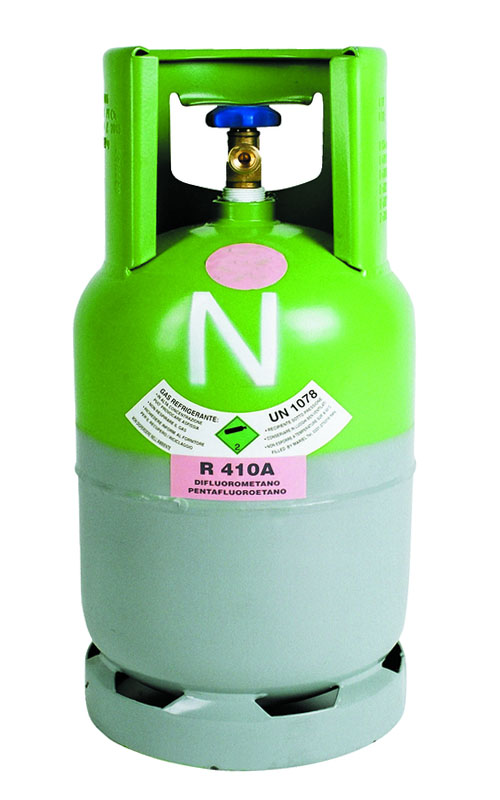
For this reason freons are the ideal refrigerant fluids for vapour-compression refrigeration cycles. They are safe compounds owing to their very high stability with respect to many chemical agents.
They are biologically inert. They are non-flammable and have an anticatalytic action on fire, so much so that they are used as gaseous extinguishing agents for fire extinguishers under the name of halons.
One of the undesirable effects of inert gases such as halons is that, in the event of leaks in confined spaces, they deplete the oxygen content, causing asphyxiation.
One class of freons, chlorofluorocarbons (CFCs), owing to their chemical inertness, have also been used as aerosol propellants, as solvents in the chemical industry and as tracer fluids.
The lighter compounds containing chlorine and bromine have now been abandoned and outlawed, because they are considered responsible for the “ozone hole”, i.e. the degradation of the ozone layer in the upper atmosphere at high latitudes.
Freons are classified in the family of alkyl halides, so their names should follow the rules of chemical nomenclature. Outside academic circles, the ASHRAE classification, first standardised in 1957 and still in use today, remains widely used.
Depending on whether or not they contain chlorine, freons are divided into:
CFCs (chlorofluorocarbons): these are hydrocarbons with no hydrogen atoms, and they are no longer used because of their harmfulness to the stratospheric ozone layer (harmfulness due exclusively to chlorine); CFCs (fully chlorinated or fluorinated) are commonly colourless gases, odourless or with a faint ether-like odour, non-flammable, chemically stable and without any toxic action
HCFCs (hydrochlorofluorocarbons): compared with CFCs they contain hydrogen and therefore less chlorine; they are thus less dangerous for the ozone layer, but these gases are no longer used either; these compounds, containing at least one hydrogen atom, are more toxic than their CFC counterparts
HFCs (hydrofluorocarbons): these are completely free of chlorine and therefore do not pose a problem as far as ozone is concerned; it should be stressed, however, that all these fluids (HFCs and so-called ecological fluids such as R410a) contribute to the greenhouse effect;
HFEs (hydrofluoroethers): these are fluorinated molecules characterised by ether-type bonds, i.e. they also contain oxygen; they are not harmful to the ozone layer and have a low GWP
CFEs (chlorofluoroethers): these are fluorinated molecules characterised by ether-type bonds, but also containing chlorine